
Mercura
An AI traffic optimization company. Mercura retimes a whole grid of signals at once using data cities already collect, validated on a calibrated 24-intersection model of east Toronto against the timings running there today.
Mercura is a company I started to fix traffic with software instead of concrete. Roughly 45% of urban congestion comes from bottlenecks and poor signal timing rather than from too many cars, which makes a large part of it a software problem. Toronto runs about 2,500 signalized intersections and 87.4% of them are on preset fixed timings, most written years ago, each one deciding on its own with no idea what the next one is doing. Congestion costs the Greater Toronto and Hamilton Area around $44 billion a year and takes over 100 hours from the average driver.
The pitch is one sentence: make the lights smarter without touching the lights. Cities already have what is needed. Induction loops in the road, probe and origin-destination feeds from navigation apps and fleets, transit schedules, and signal controllers that can now be reprogrammed remotely. What is missing is the brain that treats the grid as one system instead of thousands of disconnected pieces, including the disruptions that drive a large share of congestion: construction, events, weather.
V1 is a genetic algorithm optimizer running on SUMO microsimulation. It tunes cycle lengths, splits, offsets and protected-left phases across every intersection jointly, scoring each candidate plan by simulating real vehicle movement rather than estimating delay from a formula. The plan the city currently runs is seeded into the search, so the optimized plan can never come out worse than what is deployed today. Minimum green times, pedestrian clearance intervals and yellow and all-red minimums are hard floors the optimizer cannot trade away, and the whole thing runs on commodity desktop hardware, which keeps re-optimization cheap enough to repeat weekly and per condition.
The study network is a 24-intersection signalized grid in east Toronto, 34 signals modelled and 24 optimized, covering the Danforth, Gerrard and Dundas arterials between Pape and Coxwell. Roughly 3.5 by 3.9 km and 250 lane-km of congested, coordinated road, which is the setting where network-level timing has the most to gain.
Getting the simulation honest mattered more than the optimizer did. The model is calibrated against City of Toronto turning-movement counts at PM peak, routed on the TTS 2022 origin-destination matrix, with TTC buses and streetcars modelled from GTFS and HERE Traffic API segment flows as corroboration. 93.8% of 224 counted approaches fall within GEH < 5, against the 85% threshold that is the standard acceptance criterion in traffic modelling, with zero simulation teleports.
Against the timings actually deployed on that grid, V1 cut average vehicle delay by 7.4%, stopped and waiting time by 9.3%, corridor travel time by 2.7%, stops per vehicle by 2.4%, and fuel and CO2 by 2.3%, with no gridlock events in any run. Benchmarked inside the same simulation harness it lands at 73.8 seconds of average delay per vehicle against 79.7 for the field plan, 83.3 for Webster and 84.0 for a Synchro-style proxy, beating both conventional retiming methods by 11% to 12%.
Earlier versions of this reported much larger gains, 22.5% off waiting time and 12.7% off travel time, from a four-intersection corridor running a far rougher model. Those numbers are in my first two write-ups and I do not stand behind them. The calibrated 24-intersection results above are the ones worth quoting, and they are smaller and real.
Most of the work was not modelling. It was getting the data and getting in front of people. I cold-emailed and messaged city staff, transit agencies, data providers and traffic engineering firms to get at turning-movement counts, signal timing sheets and origin-destination data, and took meetings with anyone who would give me one. The work was reviewed by Baher Abdulhai, a professor of Civil and Mineral Engineering at the University of Toronto and an intelligent transportation systems specialist, and by Luke Piette, Director of Product-Led Growth at RunPod. Mercura also went through Concept Catalyst, Innovation Factory's program for early-stage founders.
The commercial shape mattered as much as the model. Hardware-led competitors need new sensors at every intersection, which is exactly why so few cities have grid-wide coordination: the bottleneck is procurement cycles and capital cost, not ideas. Software that improves what is already in the ground deploys in months instead of years. It is also built for the city's engineer rather than around them. Mercura supplies optimized plans plus before and after validation, and the city's Professional Engineer reviews, approves and keeps full authority over anything that reaches a live signal.

Mercura logo 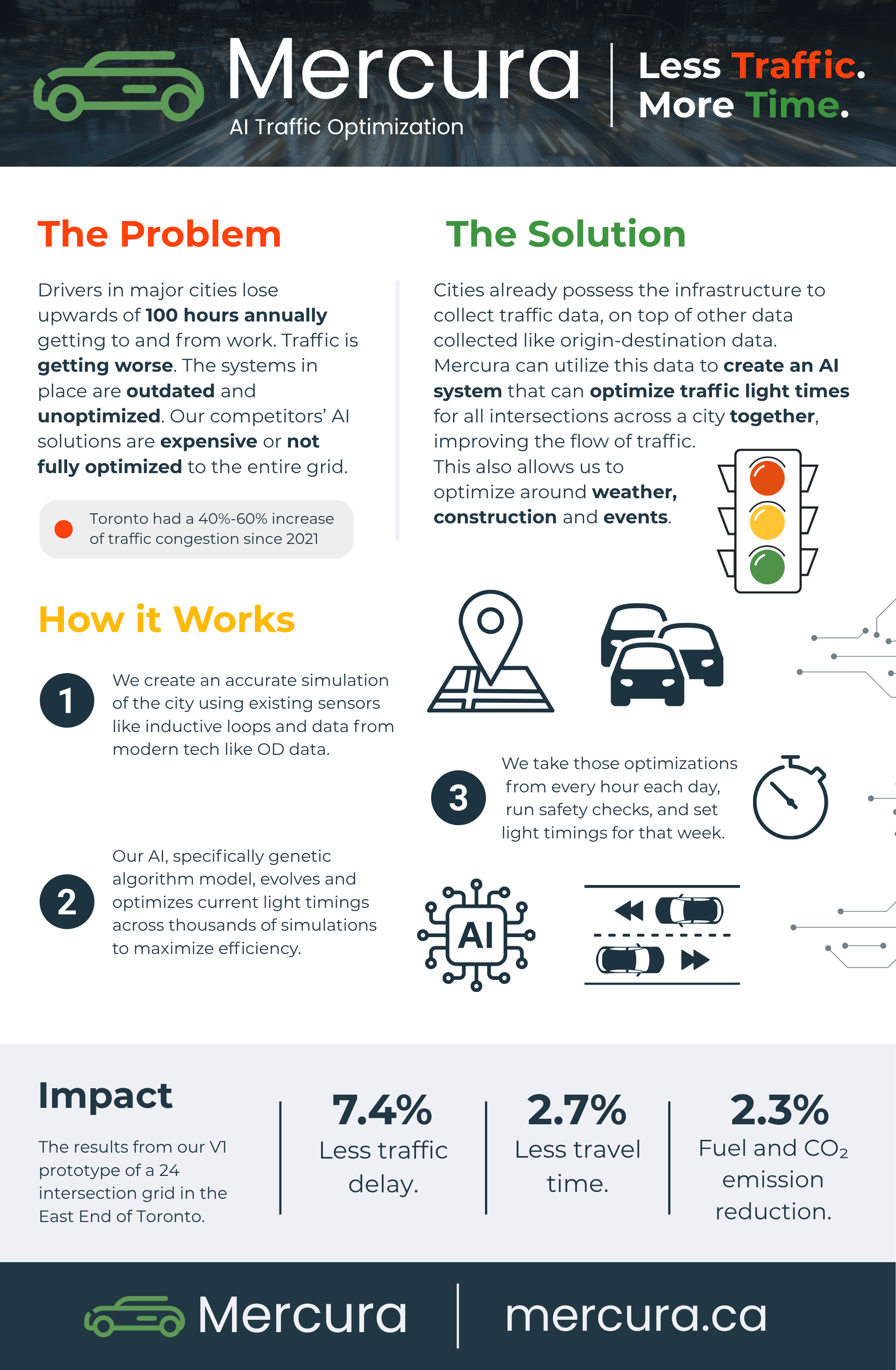
The one pager
Related work
TKS x Lovable Challenge
A winning TKS challenge recommendation for Lovable: a creator-led template marketplace where every template becomes its own search entry point, modelled at 75M+ new users and $450M+ in annual recurring revenue without paid acquisition.
View projectAI & robotics · January 2026AI Trash Sorting Robot
A trash can that sees what is being thrown out and puts it in the correct bin, saving you the hassle and keeping recyclables out of the landfill.
View project